It Always Begins with A Dream
That Good at It
If the goal of this book is to teach radical self-responsibility and master your Mental Aggression, then the career of a professional racer is the final exam. Amateurs confuse the dream with the discipline. They focus on the bike, but professionals win the $7 million contract through their game intelligence and off-track Business Aggression. To become one of the few, you must not only be the most disciplined rider on the track but also the most marketable, mentally tough CEO of your own career. This chapter separates the dreamers from the deadly focused, showing where true mental work is done.
If I would get a dollar each time someone asks me how to become a professional racer, I’d be wealthy. Please have a thick skin for this one. I am a strong believer in dreams, because all good things BEGIN WITH A DREAM, but becoming a professional racer is something only a few can turn into reality. I was one, and now I’m a professional coach—which is why I know.
An easy and straight up way to put it is: You gotta be THAT GOOD AT IT that you get paid for it. If you are NOT GOOD AT IT—you won’t. That explains a lot and makes dreams pop like soap bubbles already, doesn’t it?! Especially when you just started racing and look out to those stars by asking that question too early. Cuz’ by that time—how do you know that you’ll ever be THAT GOOD AT IT?! If you look out that far too early, you just make yourself a six-year-old who says ‘I wanna be an astronaut when I’m grown up’. Not saying it’s impossible—but it kinda skips quite some significant steps there. Btw… nowadays you kinda have to be on the race bike at an age of 6 years already to eventually make pro level. If you are not, then I suggest you make sure to graduate school so that you have a plan B. Sorry for the brutal honesty.
Defining “Professional”
Let’s define something before we go deeper into this. I noticed that some people claim the title ‘professional’ because they’re fast—or someone calls an instructor at a track day a ‘professional’ while they are not actually. It seems this term has become an indicator for skill level, like: Amateur > Advanced > Professional. So like a replacement for ‘Expert’ kinda thing.
In fact—they are not professionals, unless they can make a living of it so that they don’t have to follow any other regular full or part-time jobs anymore. That’s a professional.
24/7 Pro Package
Ok, so let me wrap up what it means to become one of those few. It comes with broken bones, blood, dedication, discipline, soul, life-changing decisions, sweat, fitness, age, management skills, organization, relationships, and a drop-dead killer instinct. There is way more going into this. Things which are off-bike and off-track. You are doing things according to create or to maintain your ‘market value’. At this point… OMG, just overthinking all the facets is almost impossible to bring this together here. But let me try…
Being a professional racer is a 24/7, 365 days a year job. You have ‘vacation’ during the time your bones are healing and skin slowly closes your wounds. I did 30 kilometers per day on a mountain-bike. Your daily nutrition is carefully picked. In other words, also your family has to play along with your racing life cycle.
Between scheduled testing new parts, you travel a lot from track to track or to the team quarters. You have an appointment for a TV show or a radio podcast interview to do. Magazines or newspapers are calling for interviews. You’re sending pictures and autograph cards to fans. Some fan created a fan club and you are around once in a while. You organize team travels and dates for an entire calendar year. Just think of the time and money that point consumes. One of your local sponsors has an event and wants you to pick up your new mountain-bike, which he gives you for that while press is there. You shake lots of hands and smile into cameras even if you don’t feel like it. You have lots of dinners with team owners who want you to race for them. You have to evaluate a lot and make the right career decisions.
In-between you do Moto Cross and whatnot, just to kick and haul ass. You have dinners with sponsors or those who hopefully become one.
This is just a fraction of the ‘pro package’, and if you call someone a professional while they are not… then you literally slap those few in the face and take their credit away from being a real professional, because they are THAT GOOD AT IT—on AND off the race bike.
 Getting Hired?
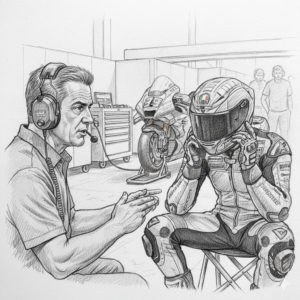
Most likely you won’t, unless you are already THAT GOOD AT IT. If so, then this is either the so called ‘Works team‘ (for example: Yamaha Factory Racing, HRC Honda Racing Corporation, etc) or a ‘Satellite Racing Team‘ (like: LCR, Tech3, etc). By then though, you are a professional for a while already.
You’ll most likely run this just like a business. You won’t EVER get a million-dollar Red Bull contract out of the blue. It takes time to find the right relationships. As your calendar fills up and you got tons better AT IT, you might turn product sponsorship contracts to monetary support a little. From here it might be enough to have a regular part-time job now, and boom—you’d be a Semi-Pro. At this point you’ll pay taxes for this and your life has been immensely changed by then.
All of a sudden there is this championship winning team who just lost their number one racer due to injuries. They call you because they know that you are about to be THAT GOOD AT IT, and you go contact the relationships you’ve built and tell them about this opportunity. An opportunity which attracts press, fans, other teams… and the circle is closing! You are about to be a professional racer, who gets paid because you’re THAT GOOD AT IT.
How Much Can You Make?
A pro racer is a promoting machine which has a market value. That value depends on many things: Character, personality, skill, fan base, intelligence, press attractiveness and much more—all that grows into your racing skill/appearance. Look, I don’t want to sound mean, but if you don’t have the personality to close a sponsor contract with a bunch of zero’s, then you very likely walk away with 2 sets of tires, right?! Your race personality plays into that. Some have more fans crashing all the time just because they’re ‘bad ass’. Make sense?
There was a German world champion in the 90s. While he barely collected $300,000 for his next MotoGP season, some developing Italian got $7 million for finishing the season 5th. Honda Racing saw more in this guy, and to be able to promote the brand. If you look like you’d ‘race for free’ and the umbrella girl next to you steals the show, then you know why. You’re not walking through the paddock, low on confidence and in unhealthy flip-flops—but expect to be seen by fans, press and sponsors. There has to be an aura, attitude, personality, and a GAME intelligence.
So there is no exact amount. It’s pretty much what you can make of it. Sky can be the limit, and that could be product sponsorships, monetary sponsorships, licensing, TV rights/share, merchandising, royalties, season bonuses, cash for wins/results, or/and top league… a permanent pay check from a team.
Now What?
I know. It sounds like that you’d have to be born with all this to become a professional. Trust me, all this is learnable and you grow into it. Let’s not destroy dreams… let’s have many. Now here is what I want you to do as an amateur racer…
You go race the living dead out of it. You develop a racing intelligence. Have an attitude and show personality god damn it. Be the one to beat and make others feel this. Create little relationships with sponsors. Ask for discounts, then for this or that product for free—and when time comes and competition level grows, you ask for money. Run your own team and learn things around it. Look good—just like you could promote something.
Then you might become THAT GOOD AT IT that some team calls you up and ask you to race for them—OR you find sponsors so you can buy yourself into a team (they hand-pick!) which has the man and equipment power to win international championships.
Then… you might don’t need to do a regular job anymore. BUT make sure you play and race real well, because pro athletes have an expiration date. Pro racers are like comets… they are glowing bright for a short moment in time only.
Psychological Takeaway
The Dream is a necessary starting point—it’s the fuel—but psychologically, it is also a trap. The difference between a professional and an amateur lies entirely in what they do after the dream hits them.
The Amateur’s Fantasy Motivation
For the amateur, the “Dream” operates as a form of Outcome Goal Fixation fueled by Extrinsic Motivation.
- The Trap of the “Big Outcome”: The amateur sees only the final picture: the championship, the contract, the fame. This is uncontrollable fantasy. The moment you face a setback (a crash or loss), your motivation collapses because the immediate dream is shattered.
- Waiting for Recognition: The amateur believes the world (or a sponsor/team) should reward their raw, unproven potential. This is a passive, External Locus of Control mindset. You wait for the reward before you’ve done the work, making you mentally reactive and easily discouraged.
- The Psychological Wall: When the harsh reality of training, expense, and losing hits, the amateur runs straight into Denial and Anger. You blame the bike, the track, or the system, rather than accepting that the dream needs to be dismantled and rebuilt into a sustainable process.
The Power of the System
The professional understands that the Dream must be immediately converted into an actionable System fueled by Intrinsic Motivation.
- System over the Goal: The pro breaks the massive “Dream” into thousands of tiny, controllable Process Goals (e.g., improve braking pressure by 5%, master the Turn 3 line).
- Winning the Decade, Not the Day: Professionals focus on consistency, learning, and long-term development. They view a bad race not as the death of the dream, but as crucial feedback required for system improvement. Their Internal Locus of Control means they always look inward for solutions.
- Mastery over Recognition: The pro’s motivation shifts from “I want others to recognize my talent” to “I am driven by the relentless pursuit of mastery.” This self-sustaining motivation ensures they do the hard work even when they don’t feel like it because they value the process of improvement itself.
The psychological journey of this chapter is about learning to let go of the romanticized ‘Dream’ as a source of energy and replacing it with the disciplined ‘System’ as a source of sustained success.

🏁 Mind Note – Success!
“The difference between a successful person and others is not a lack of strength, not a lack of knowledge, but rather a lack of will.”
— Vince Lombardi
Click to Open Chapter Two: Find Support for a Racing Career